

What Makes a Roadliner Pad Last? It Starts with the Steel Core
Posted by Ashley Wetherbee on Jul 31st 2026
Rubber Track Pad Education
What Makes a Roadliner Pad Last? It Starts with the Steel Core
Rubber composition gets plenty of attention, but the steel plate underneath plays a major role in how well a roadliner pad handles heavy loads, resists cracking, and performs on demanding jobsites.
Why Steel Plate Design Matters
Two roadliner pads may look nearly identical from the outside, yet perform very differently once installed. Much of that difference can be hidden beneath the rubber.
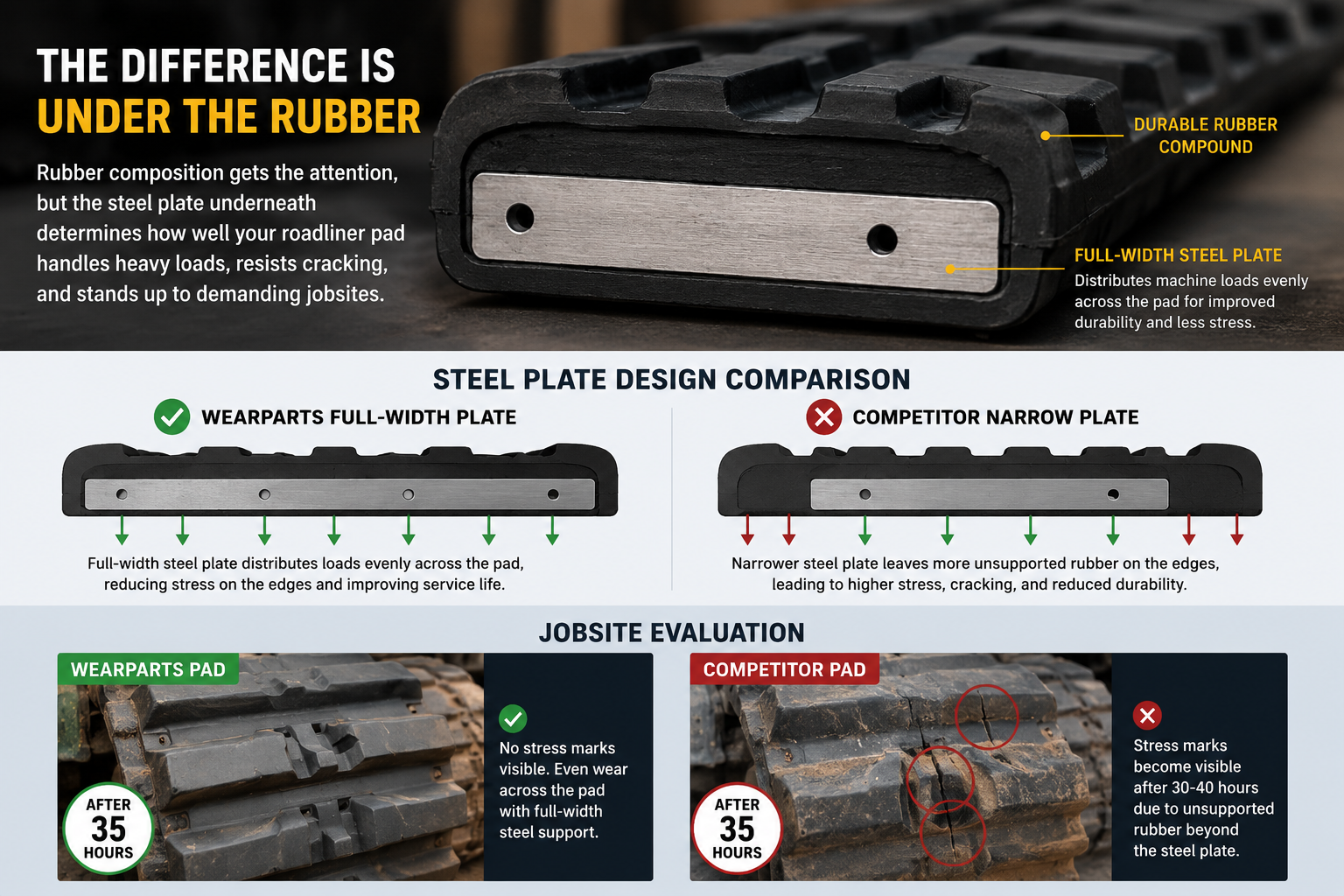
The internal steel plate supports the rubber pad and helps distribute the weight and operating forces created by the machine. When the plate provides broad, consistent support, stress is spread more evenly across the pad instead of concentrating around unsupported edges.
A narrower or undersized plate can leave more rubber extending beyond the supported area. Under repeated machine weight, turning forces, impact, and vibration, those unsupported areas may be more likely to flex, develop stress marks, crack, or tear.
Full-Width Support Helps Distribute Machine Load
A properly engineered steel core is designed to carry load across more of the pad’s width. This can help reduce localized stress and provide more consistent support as the machine travels, turns, and works over hard surfaces.
Broader Steel Plate
Supports more of the rubber pad, helps distribute machine weight, and may reduce stress concentrations near the outer edges.
Narrower Steel Plate
Leaves a larger unsupported rubber area that may flex more under repeated loading, turning, and impact.
What Stress Marks Can Tell You
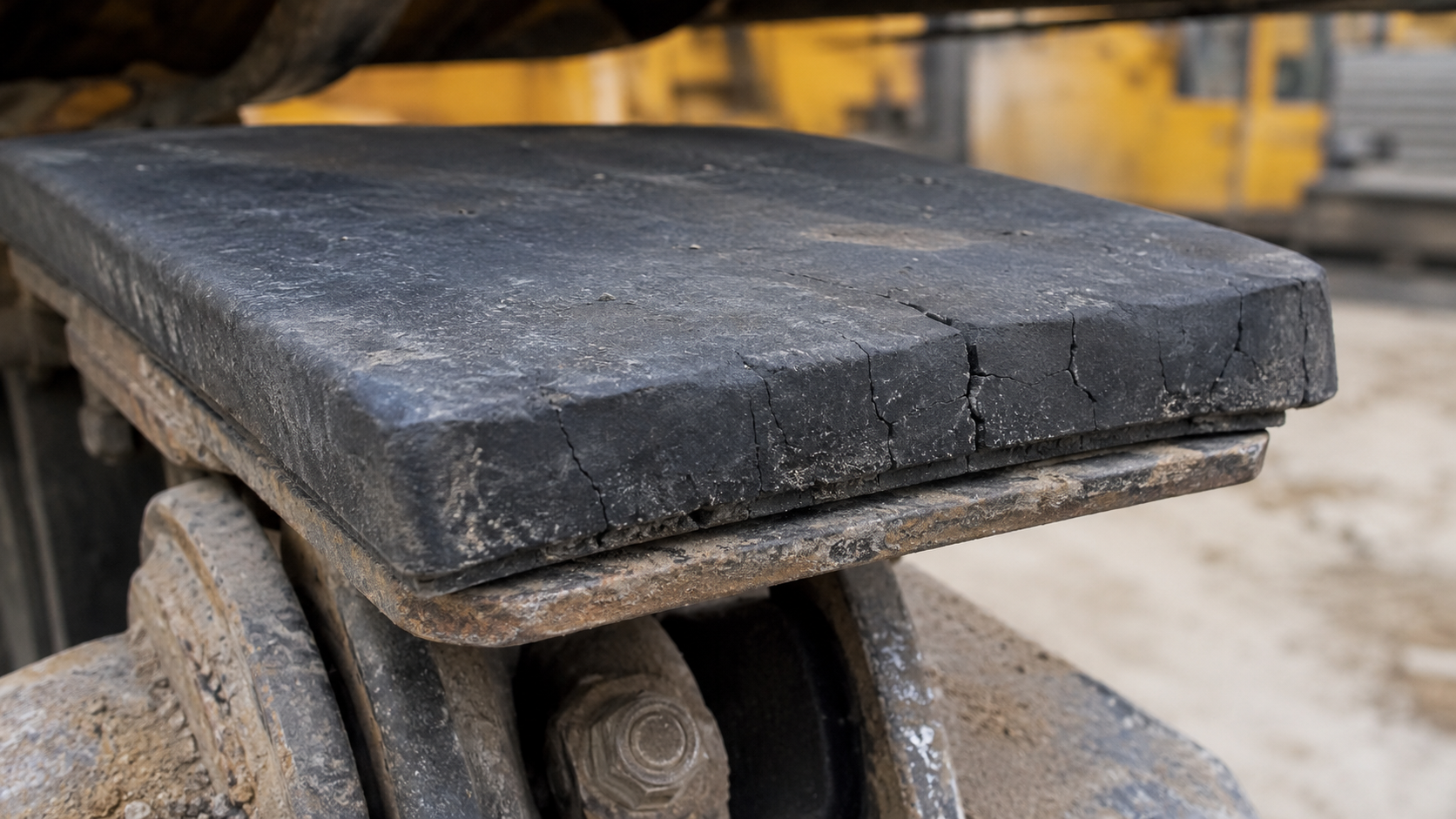
Early stress marks can indicate that the rubber is flexing repeatedly around the edge of the internal steel plate. These marks may appear as faint lines, surface cracking, edge distortion, or separation in areas that receive repeated load.
Stress marks do not always mean immediate pad failure, but they can be an early sign that the rubber is carrying more strain than intended. Over time, continued flexing may contribute to cracking, chunking, tearing, or separation from the steel core.
Roadliner Pad Performance Depends on More Than Rubber
The rubber compound is still important. It must resist abrasion, tearing, heat buildup, and repeated deformation. However, even a strong rubber compound performs best when it is properly supported underneath.
A durable roadliner pad depends on the complete design working together:
- A properly sized and shaped steel plate
- Consistent rubber coverage and bonding
- Correct bolt-hole placement and mounting dimensions
- A rubber compound suited to the operating environment
- Proper installation and bolt torque
- The correct pad width and fitment for the machine
Common Causes of Premature Roadliner Pad Damage
Unsupported Rubber
Excess rubber beyond the steel core may flex and experience concentrated stress.
Incorrect Installation
Loose, unevenly tightened, or incorrect hardware can allow movement and increase pad damage.
Aggressive Turning
Sharp turns on abrasive surfaces place additional lateral force on the rubber pads.
Incorrect Fitment
The wrong pad dimensions or bolt pattern can prevent proper seating and load distribution.
How to Choose the Correct Roadliner Pads
Do not rely on machine model alone when ordering replacement pads. Machines may have different track-chain configurations, serial-number breaks, or aftermarket undercarriage components.
For accurate fitment, confirm:
- Machine manufacturer, model, and serial number
- Track-pad width
- Bolt-hole count and spacing
- Bolt diameter
- Track-chain pitch
- Existing pad measurements
- Photos of the current pad and mounting surface
Build Your Machine on Better Parts
- Durable rubber compounds designed to maintain shape and strength
- Steel-core support engineered for demanding applications
- Fitment assistance using machine and pad measurements
- Shipping available throughout the United States
Construction Parts PNW supplies bolt-on rubber pads and roadliner pads for excavators and other tracked equipment.
Need help finding the correct pads? Send us your machine model, serial number, pad measurements, bolt pattern, and photos for fitment assistance.